
This “virtuosic”, politically charged triumph is “horrifying yet ridiculously funny”. It’s rare to see such an ambitious film work so smoothly.
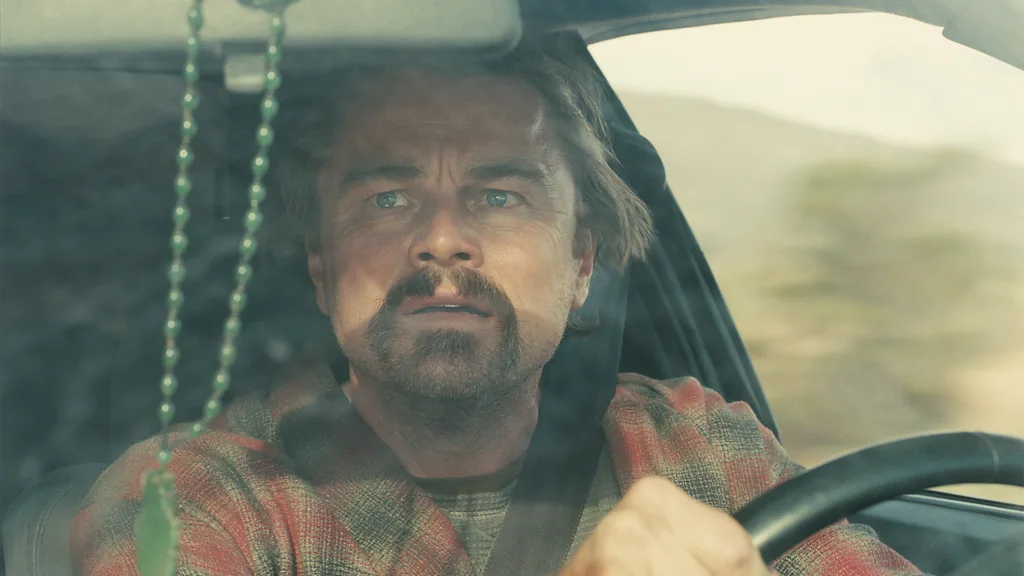
Paul Thomas Anderson is the brilliant mind and Leonardo DiCaprio the emotional heart of this timely, audacious comic-action-drama One Battle After Another. As Bob, a former radical now content to drink and smoke all day long, DiCaprio races around in a plaid bathrobe and a beanie trying to rescue his abducted teenage daughter. It’s a funny turn, but the love and fear in his eyes tell you how deeply Bob feels. That is just one element of the film, which is also full of car chases, militias, shadowy organisations, loyalties and betrayals, all fused in a story that pulls you along from start to finish and that is jolting in its political immediacy. It’s rare to see such an ambitious film work so smoothly, but then, one of Anderson’s signatures is his ability to coolly control raucous, sprawling stories.
Throughout his career, he has had a distinctive voice – crisp, clear, elegant and funny – but those qualities pop up in a variety of styles, including the intense There Will Be Blood (2007) and the elegant Phantom Thread (2017). One Battle After Another brings together several strands, particularly the comic glee of Boogie Nights (1997) and the juggling act of multiple stories in Magnolia (1999).
It’s also his second film to be influenced by a Thomas Pynchon novel. Inherent Vice (2014) was the first, and One Battle After Another was inspired by Pynchon’s 1990 novel, Vineland, about a leftover 1960s radical, two decades on. Anderson has borrowed just a whiff of the plot, updated it to the present and created entirely new characters, yet he has kept the soul of a Pynchon novel: there are hints of it in some cartoonish names and in the antic comedy. Most importantly, Pynchon was sending up nefarious quasi-government organisations in his novels – as Anderson does here with comic yet deadly-serious finesse – long before conspiracy theories went mainstream.

The taut early scenes are set at a holding centre for immigrants, where military guards prowl behind chain-link fences, in images clearly meant to echo those seen on the news. A fictional group called the French 75 infiltrate the site to announce the revolution. Among its members, Perfidia Beverly Hills (Teyana Taylor) is tough and uncompromising. Bob is their explosives expert and her lover. The film is nuanced enough to understand the radicals’ goals, yet it makes no excuses for their violent actions.
At the immigrant centre, Perfidia encounters the sinister Captain Steven Lockjaw, a character as broadly drawn as his name. Sean Penn makes him thoroughly convincing as a sexual creep who later bullies and blackmails her, and who admits that he is drawn to her because she is black. Perfidia soon goes underground, abandoning Bob and their baby, and it’s enough to say here that her perfidious name suggests duplicity for a reason.
The opening sequences are taut, but the film really takes off and the comedy comes in when the story jumps ahead 16 years and lands in Bob’s small house. As he showed in Catch Me If You Can (2002), DiCaprio has more flair for comedy than he’s known for. He makes Bob’s goofiness and shambolic way of life – drinking, smoking and watching the political film The Battle of Algiers (1966) on television – amusing in itself. But DiCaprio also displays Bob’s fierce love for his daughter, Willa (a poised and confident Chase Infiniti), with just a few touches. It’s in the sweet way he calls her “Honey” and the concern in his eyes, which Anderson captures in close-up. For all his wit, Anderson can be a chilly, cerebral film-maker, and DiCaprio’s emotional warmth in the role balances that.
Drama and comedy co-exist with remarkable, virtuosic ease here. One of the plot threads Anderson weaves in so well is Lockjaw’s attempt to join the Christmas Adventurers Club, a secret society of white supremacists – which, given his old obsession with Perfidia, is the ultimate hypocrisy. Anderson deftly makes the organisation horrifying yet ridiculously funny, a group of rich white men (Tony Goldwyn plays one of its leaders) who insist they are “superior human beings”. His membership bid leads Lockjaw to send a militia to prowl Bob’s town of Baktan Cross, rounding up migrants as a pretext for finding Bob and Willa. The enigmatic military figures are unidentified, with no official insignia on their fatigues, a touch that only makes them more ominous.
Silly and tragic also mix when Willa is taken, and Bob has forgotten the password he needs to get help from his old radical group, now underground. DiCaprio is at his comic best as Bob fumbles through the nightmare of trying to find her, enlisting her karate teacher, always called Sensei (Benicio del Toro). Sensei combines helping Bob with racing to save migrants from a raid by Lockjaw’s troops. The raid actually resonates with current events better than it fits in the film, but Anderson and the actors make it work.
All of this leads to a car chase up and down hills that makes you feel as if you’re on a roller coaster in a vast, desolate desert landscape. The film, which was shot in widescreen VistaVision, has an epic feel throughout, whether it depicts a large military helicopter landing or a ramshackle street in Baktan Cross.
Salman Rushdie, reviewing Pynchon’s Vineland 35 years ago, called it “a major political novel about what America has been doing to itself.” And at a Q&A with Anderson several weeks ago, Steven Spielberg praised the film as “increasingly more relevant than perhaps even when you finished the screenplay”. American society, in all its strengths and missteps, has been a major theme for both Pynchon and Anderson, and it grounds Anderson’s dazzler of a film, giving it an emphatic, unmistakable political charge. – BBC
By Caryn James