
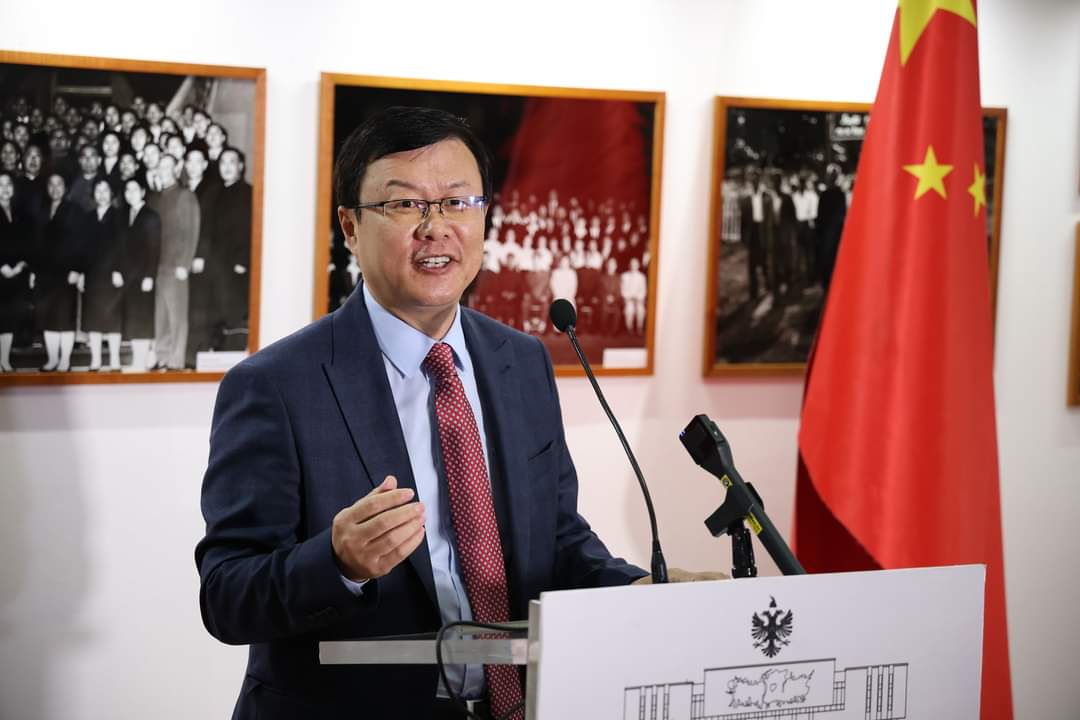
ZHOU DENG
THIS year stands out as a landmark of great achievements for both Zimbabwe and for China-Zimbabwe relations.
With 2026 on the horizon, now is the perfect time to reflect on our shared journey and plan for the year ahead.
This seminar comes right after two pivotal events: the conclusion of the Fourth Plenary Session of the 20th Central Committee of the Communist Party of China (CPC), and the 22nd National People’s Conference of Zanu PF. Furthermore, the CPC has just unveiled its Recommendations for the formulation of China’s 15th Five-Year Plan, and Zimbabwe has formulated its National Development Strategy 2 (NDS2).

The theme of the seminar— “China-Zimbabwe Dialogue: Aligning China’s 15th Five-Year Plan with Zimbabwe’s Vision 2030”—could not be more pertinent. It is our common desire to ensure our national blueprints bring mutual prosperity.
Please allow me to begin by outlining the significance of the Fourth Plenary Session of the 20th CPC Central Committee. Convened at a pivotal moment for concluding China’s 14th Five-Year Plan, this session set the direction and drew a blueprint for our nation’s next chapter.
Over the decades, China has achieved the twin miracles of rapid economic development and long-term social stability — a rare feat in global development history.
In 2024, China’s GDP surpassed US$17.74 trillion.
For 15 consecutive years, we have been the world’s largest manufacturer. From 2021 to 2025, our contribution to global economic growth has consistently averaged around 30 percent, serving as a primary stabiliser and engine for the global economy.
Against this backdrop, the Fourth Plenary Session of the 20th CPC Central Committee deliberated and adopted the “Recommendations for Formulating the 15th Five-Year Plan”, laying out a clear roadmap for China’s development from 2026 to 2030.
The formulation of this plan embodies a core governance principle, combining top-level design with grassroots wisdom. This approach is enshrined in what we call “whole-process people’s democracy.”
To this end, a dedicated online portal collected over 3.1 million public suggestions in just one month, covering a vast spectrum of topics from technological innovation to social welfare.
In addition, the scientific formulation and successive implementation of Five-Year Plans also underscore a key strength of China’s governance, the capacity for long-term strategic planning, consistent implementation, and delivering tangible results.
At a time of rising global uncertainties, the 15th Five-Year Plan will provide, not only continuity and stability for China’s own development, but also valuable opportunities and confidence for the international community and our global partners, including Zimbabwe.
The Fourth Plenary Session has also reaffirmed six core guiding principles: upholding CPC leadership, putting people first, advancing high-quality development, deepening reform and opening-up, harmonising market dynamism with effective governance, and integrating development with security.
Guided by these principles, the 15th Five-Year Plan sets key objectives across critical domains: advancing science and technology, promoting ecological progress, fostering cultural development, strengthening national security, and above all, enhancing people’s wellbeing — by consolidating and expanding poverty alleviation gains, addressing their pressing concerns, and fulfilling the aspirations of 1.4 billion people for a higher-quality, more dignified life.
Notably, the 15th Five-Year Plan also reaffirms China’s commitment to high-standard opening-up. As the world’s second-largest economy, China will continue to prioritize two-way trade and investment, and seek to fortify industrial and supply-chain cooperation with our international partners.
Over the past five years, as China implemented its 14th Five-Year Plan and Zimbabwe pursued its National Development Strategy 1 (NDS1), we have witnessed remarkable achievements in our bilateral cooperation—achievements we can all be proud of.
Our bilateral trade volume reached US$3.12 billion in 2023 and surged to US$3.8 billion in 2024. Zimbabwe’s tobacco exports to China alone sustain approximately half a million local jobs. Since 2022, more than 1 400 new Chinese-invested enterprises have been registered in Zimbabwe, with a projected investment value exceeding US$10 billion.
Collectively, China’s trade and investment endeavors now underpin the livelihoods of more than one million Zimbabweans.
Beyond private sector investment, Zimbabwe has also benefited from key projects built with Chinese government grants and concessional loans.
These initiatives span critical infrastructure: from the upgrade of the Hwange Power Station’s Units 7 and 8 and Kariba South Power Station, to the expansion of the Victoria Falls and Robert Mugabe International Airports; from the drilling of over 1 300 boreholes nationwide, to the construction of the magnificent New Parliament Building and National Pharmaceutical Warehouse.
What is particularly inspiring is that our cooperation is moving more into high-tech and new energy sectors. Projects like the NetOne Broadband initiative and the High-Performance Computing Centre has laid a solid foundation for Zimbabwe’s digital transformation, bridging digital divide and empowering local communities.
Large-scale solar power stations, invested by Chinese companies, will soon provide an additional 1 000 megawatts of clean energy, powering Zimbabwe’s sustainable future.
While boosting trade and investment, we are fully aware that human resources development is the cornerstone of Zimbabwe’s socio-economic progress; we have accordingly prioritized it as a key area of cooperation.
In the past five years, more than 3 000 Zimbabwean students have pursued academic studies in China, while over 2 000 government and Party officials and professionals have honed their skills through specialized seminars, workshops, and capacity-building programmes in China.
I’m pleased to see that many of you here today are alumni of these exchange programmes. And I feel proud and grateful that you have become catalysts for Zimbabwe’s development and dedicated promoters of our great partnership.
As we look back on our accomplishments, our vision is set on the future of China-Zimbabwe relations. His Excellency President Mnangagwa’s September trip to Beijing was historic, culminating in our leaders’ decision to elevate our bilateral ties to an “All-Weather Community with a Shared Future.”
This milestone opens a new chapter and injects new momentum into our partnership. I am thrilled to learn that next week, His Excellency President Mnangagwa will officially launch NDS2, which aims to accelerate Zimbabwe’s journey towards Vision 2030.
I’m confident that China’s 15th Five-Year Plan and NDS2 will unlock fresh opportunities for win-win cooperation. As NDS2 identifies 10 national priorities, including accelerating economic growth, enhancing resilience in food security, advancing digital transformation, and human capital development, I see great potential in our cooperation:
First, on trade and investment. In June this year, His Excellency President Xi Jinping announced that the Chinese Government would grant zero-tariff treatment to 53 African countries, including Zimbabwe. This strategic policy is specifically designed to facilitate African nations’ exports to the vast Chinese market.
For Zimbabwe, this will not only increase exports; it will also catalyze the development of stronger regional value chains in manufacturing. Ultimately, this will create more jobs and raise incomes for Zimbabwean people. I look forward to the signing of the Agreement between the two sides.
Second, a Green Energy Partnership. China is a global leader in renewable technologies —including solar power, hydropower, and energy storage. Zimbabwe, meanwhile, is blessed with immense solar potential. This makes our collaboration a natural fit. Our joint efforts will be instrumental in tackling Zimbabwe’s energy challenges, paving the way for a greener, more sustainable, and energy-secure future.
Third, on Infrastructure Development. Zimbabwe’s ambitious national goals for highways and railways, digital network expansion, and smart city development align perfectly with Chinese companies’ extensive expertise.
These aspirations will connect communities, facilitate trade and investment, and boost economic activity nationwide.
Fourth, human resources development. We will continue to offer scholarships, professional training, and vocational education programmes, to nurture Zimbabwean talents — the key drivers of its national development.
As we strive together to build a China-Zimbabwe community with a shared future under the strategic guidance of our heads of state, we must also honestly confront our common risks and challenges. Let me reiterate a fundamental principle: all enterprises operating in Zimbabwe — including Chinese companies — must strictly comply with Zimbabwean laws and regulations.
At the same time, I must voice our concern that the spread of disinformation is eroding public trust in institutions and damaging Zimbabwe’s investment climate. As we welcome constructive criticism, we must also resolutely oppose sensationalized and defamatory narratives.
To ensure the success of our bilateral cooperation, we must collectively foster a transparent and healthy business environment — one that supports Zimbabwe’s long-term development and our shared prosperity. Yesterday, His Excellency President ED Mnangagwa emphasized in his speech — and let me quote him directly:
“No investment should be hindered by bureaucratic red tape in Zimbabwe. We are entrenching a business operating environment that is consistently predictable and transparent, where enterprises and innovation are rewarded and industry thrives.” I am confident that this commitment will not only help attract more high-quality investment but also significantly deepen our mutually beneficial cooperation.
China and Zimbabwe have always been sincere, reliable partners. Today, both our nations stand at critical junctures in our respective national development journeys.
China is ready to work hand in hand with Zimbabwe through FOCAC and the four Global Initiatives proposed by His Excellency President Xi Jinping. And by synergising China’s 15th Five-Year Plan with Zimbabwe’s Vision 2030 and the upcoming National Development Strategy 2 (NDS2), we can inject new vitality into our joint pursuit of modernisation.Deng is China’s ambassador to Zimbabwe. He made this address in Harare yesterday.