
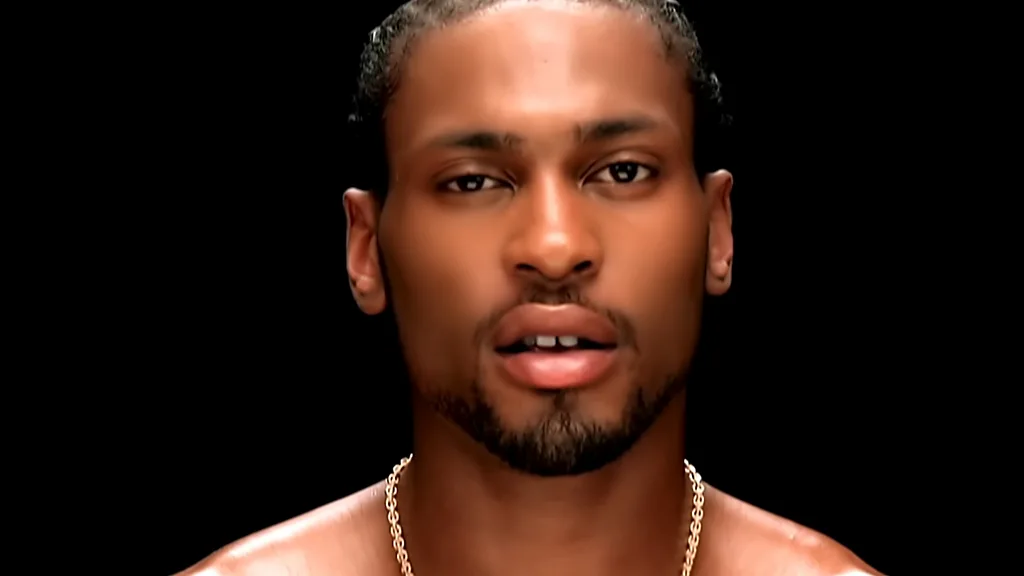
As fans honour the loss of R&B legend D’Angelo and recall his sensual, slow-burn video for Untitled (How Does It Feel), it’s time to consider if the artistry wasn’t skin-deep.
There was a point in the 1990s when R&B fans couldn’t be more scandalised. There was a sliding scale of sexuality that was either subtly imbued or gratuitously stamped across the melodies that crested the Billboard charts during the decade of D’Angelo’s 1995 Brown Sugar debut.
Groups like Intro remade Stevie Wonder’s Ribbon in The Sky, but they also sang that they wanted to slip and slide inside their listener. Elsewhere, Silk was hollering about licking someone up and down in falsetto. On the other end of the spectrum, Mint Condition, Brian McKnight and Boyz II Men sang romantic ballads about being down on one knee, despite their woman’s cheating because, “Baby, I knew about it and I just didn’t care”.
Then, D’Angelo’s Brown Sugar arrived, bringing a fusion of hip-hop, jazz, gospel and R&B in a relaxed and musical new way. It was a mellow groove, breaking through the noise with originals and remakes, like a cover of Smokey Robinson’s Cruisin’. His church boy roots shone through on songs like Higher, where the organ opens the track like a gospel revival.
But with his second album, 2000’s Voodoo, he was catapulted into the pop stratosphere when one video, Untitled (How Does It Feel), unleashed unbridled thirst, sexual exploitation and objectification on a global scale. It was a seismic shift for a preacher’s kid from Virginia who just wanted to create amazing music, like his heroes Prince or Otis Redding, but it couldn’t be undone: swivelling there as if slow-roasting, he was reduced to a beefcake live on air.
“If the Untitled video was your entry point to D’Angelo, then you missed the point,” says Dr Joan Morgan, writer and director of the Centre for Black Visual Culture at New York University. “I think what women responded to with D’s music was the fact that he really liked women. He was like a really old-school soul singer and there was no conquest mission in the music.”
As MTV takes its last gasp, shuttering its final music channels in the UK, it feels strangely nostalgic to look back to the days when multiple television channels streamed music videos for hours each day, but it gave rise to the pop-as-product 2000s and the influencer era we find ourselves in now. Artists are meant to be seen, while they are being heard. Not every artist leaned into attractiveness back then. Some made their videos work with quirkiness or humour, like Busta Rhymes or Missy Elliott’s wacky clips, which had them dressed like cartoon characters. Saucy, sensual R&B groups wouldn’t be nearly naked, but cloaked in an open leather jacket, pants and combat boots in the hot desert sun, for some reason. When Untitled dropped and a topless D’Angelo spun slowly as the camera moved in and out and up and down his torso with the speed of dripping molasses, everyone took notice.
“In college, I lived in a house with two other Black women with very different tastes in men,” recalls Fredara Hadley, an author and ethnomusicology professor at Juilliard. “But from the first chord, all three of us would crash land onto the couch to watch that Untitled video as if we had not just watched it several hours before.”
Hadley notes that the video was released during a time of female objectification in music videos across genres. Britney Spears’ Oops!… I Did It Again came out the same year, but so did Destiny’s Child’s Independent Women. And while video vixens had been spinning their careers into empowerment, men weren’t being presented solely and obviously for the female gaze. D’Angelo’s video stood out, winning him a Grammy Award for Best Male R&B Vocal Performance in 2001. Voodoo took home R&B album of the year, with love-drunk lyrics that reveal a more romantic throughline. On Lady, D’Angelo sang about loving his girlfriend and wanting to tell everyone about it. The Root is about him being so in love with a woman that he asks a doctor for help.
“It was kinda therapeutic for me to do [The Root]… because I’m so pathetic in the song,” D’Angelo says in a 1999 documentary filmed about the making of Voodoo. “That’s what The Root is, she got it on me and I’m just fucked up.”
Untitled, then, was the departure. Journalist Touré, who interviewed D’Angelo for Rolling Stone in 2000, recalled in a recent Instagram clip that the video was the brainchild of D’Angelo’s manager, Dominique Trenier. He talked him into doing it, but when he arrived at the shoot, the singer wouldn’t leave his car. After being convinced to participate, Morgan recalls a female friend who was on set that fateful day describing the event as “uncomfortable” because the “exploitation” was evident. That presence continued with Thompson describing D’Angelo doing push-ups before gigs to make sure his body was in line with the Untitled image. – BBC
By Hillary Crosley Coker