
By Beaven Dhliwayo, Group Features Editor
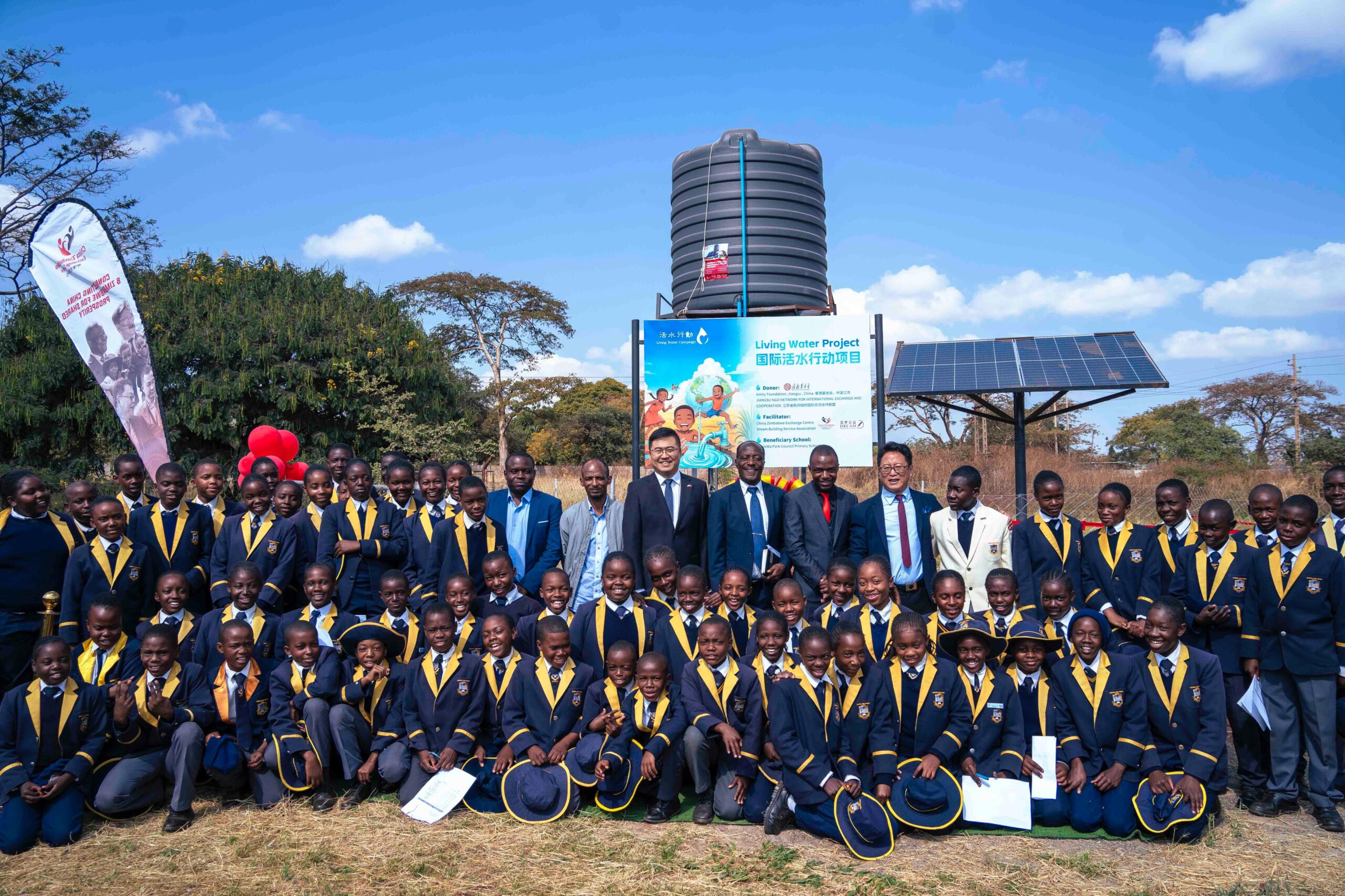
CHINA’S expanding development footprint in Zimbabwe took a meaningful turn this week as a clean water facility was officially handed over to Marimba Park Council Primary School, offering renewed hope for over 1,500 pupils and the surrounding community.
The borehole, drilled under the Amity Foundation’s International Living Water Project, was formally commissioned during a vibrant ceremony attended by school authorities, Chinese diplomats, development partners, and civic leaders.
The event marked not only a solution to the school’s longstanding water shortages but also a broader symbol of China-Zimbabwe grassroots collaboration.
“Water is life. With this borehole, we are not just hydrating bodies—we are nourishing futures,” said Zhao Ke, Chairman of the China-Zimbabwe Exchange Centre (CZEC), a key implementing partner alongside the Dream Building Service Association.
“This is a physical manifestation of our shared belief that no child should miss school due to a lack of clean water.”
Established in 1985, the Amity Foundation is one of China’s largest and most respected philanthropic organizations.
Its water projects in Africa have increasingly focused on practical solutions for schools and communities with limited access to safe drinking water.
Marimba Park Primary School Headmaster, Zata Pascal, described the borehole as transformative.
“This borehole is more than infrastructure—it is liberation,” he said.
“For years, we have struggled with an erratic water supply. At times, teachers would have to carry buckets just to ensure students could wash their hands. This gift will dramatically improve our sanitation standards and keep children in school.”
The new water point is expected to significantly improve hygiene, reduce absenteeism, and promote gender equity, as water collection responsibilities often fall on female students.
“This is a game-changer, especially for our girls,” said Tariro Muchemwa, a senior teacher.
“They can now attend class consistently without worrying about where the next bucket of water will come from.”
The guest of honour, Chinese Embassy Minister Counsellor Cheng Yan, described the project as a model for people-centered cooperation under the China-Africa framework.
“China’s friendship with Zimbabwe is not built on promises alone—it is built on results,” Cheng said. “When we talk about China-Africa cooperation, we often focus on infrastructure or trade. But this borehole shows that even small-scale, community-level projects can deliver a profound impact.”
The initiative is part of a broader commitment under the China-Zimbabwe Friendship Clean Water Project, which aims to reach underserved schools and villages with clean water infrastructure, hygiene education, and sustainable management systems.
In addition to the borehole, the project includes hygiene promotion activities and demonstrations on water conservation to ensure sustainability and responsible use of the resource.
A moving poem by the school’s senior prefect brought the crowd to silence.
“Water is a promise kept, a future unlocked,” the student read, her voice trembling with emotion.
“From far away, friends have come—not with words, but with wells.”
Community members present at the ceremony echoed appreciation for the intervention.
“For too long, we have relied on unsafe water sources. This is more than a school issue—it’s a community victory,” said Mrs. Tsitsi Banda, a Marimba Park resident and parent.
The event concluded with a tour of the new facility, where stakeholders observed how the system functions and how pupils are being trained in water-saving techniques.
A poster campaign around the school grounds underscored key messages: Save Every Drop, Clean Hands Save Lives, and Our Borehole, Our Responsibility.
As Zimbabwe continues to face infrastructural challenges, particularly in urban schools and peri-urban communities, such targeted investments are increasingly critical.
According to UNICEF, nearly one in four schools in the country lacks access to safe water, affecting both health outcomes and educational performance.
Zhao Ke reinforced that this was just the beginning.
“We are committed to expanding this work. More schools, more communities. When we empower people with the basics—water, health, education—we unlock long-term development,” he said.
In an era where international partnerships are often judged by high-level rhetoric, the Marimba Park borehole is a refreshing reminder that sustainable development begins at the grassroots—one pump, one drop, one child at a time.