


Tapiwa Chirume
STAFF WRITER
CHINA has offered to make affordable Artificial Intelligence (AI) solutions available to Zimbabwe and other African countries, potentially opening a new front in cooperation between Harare and Beijing as Zimbabwe seeks to harness technology to transform its economy.
This comes at a time when AI is rapidly reshaping business, education, research and public services worldwide, while the cost of accessing advanced technology remains a major barrier for developing economies.
Speaking at the 77th anniversary of the founding of the People’s Republic of China in Harare yesterday, Chinese ambassador to Zimbabwe Zhou Ding said Beijing was prepared to share AI technologies with developing countries to help businesses and communities unlock new opportunities and drive inclusive economic growth.
“In July 2026, China hosted the World AI Conference and the High-Level meeting on Global AI Governance, President Xi Jinping articulated China’s vision for global AI development, which prioritises safety, international cooperation, and support for developing countries,” Zhou said.
“The World Artificial Intelligence Cooperation Organisation (WAICO) has been officially launched to foster a sound AI governance architecture tailored for the Global South.
“China will set up AI cooperation hubs with Brics, Asean, the African Union and other regional frameworks. China stands ready to share affordable, accessible AI solutions to unlock local development potential, empower businesses and communities, and drive inclusive growth in Zimbabwe and across Africa,” he said.
Zhou said China-Zimbabwe cooperation had already produced tangible results across several sectors, including energy, aviation, agriculture and industrial development.
“The upgraded Robert Mugabe International Airport and Victoria Falls International Airport, funded by China, continue to serve as regional aviation hubs, enhancing Zimbabwe’s international connectivity and visibility,” he said.
“The Hwange Power Station Units 7 and 8 and the Kariba South Hydropower Station continue to supply more than half of Zimbabwe’s electricity, powering households and industries. Over the past year, we have also delivered a host of signature projects benefiting communities across Zimbabwe — including the High Performance Computing Centre, the Belt and Road Joint Laboratory on Agriculture, the Juncao Technology Assistance Project, 300 boreholes, the donation of 5 000 metric tonnes of rice, plus drought mitigation and post-disaster maternal and child health projects in partnership with UN agencies.
“These wide-ranging initiatives strongly complement the Zimbabwean Government’s endeavours to improve people’s livelihoods, advance industrial development and pursue national modernisation.
“Under Zimbabwe’s Open for Business policy, guided by market-based and commercial principles, and anchored in our traditional friendship, Chinese investment will continue to boost Zimbabwe’s industrial capacity and local value addition.”
Zhou added that more than 500 Zimbabwean officials and professionals had participated in more than 80 capacity-building programmes in China during 2026, while nearly 10 000 Zimbabweans had travelled to China in the first eight months of the year.
“These vibrant exchanges bear full testimony to the profound friendship shared by our two peoples,” he said.
Meanwhile, the minister of Higher and Tertiary Education, Frederick Shava, who represented Foreign Affairs minister Amon Murwira, said Zimbabwe’s development ambitions were inseparable from science and innovation.
“True socio-economic transformation is driven by scientific research, design thinking, and human capacity. Zimbabwe prioritises a knowledge-driven economy. To this extent, we acknowledge China’s digital and educational support,” Shava said.
He said academic scholarships and technical training programmes supported by China were also helping to empower Zimbabwean youth.
“Zimbabwe continues to modernise its Foreign Service architecture to enable seamless official exchanges, trade negotiations and institutional partnerships. The active work of our Joint Commissions ensures that agreements signed between Harare and Beijing move rapidly from dialogue to implementation.”
The AI initiative comes as Zimbabwe seeks to leverage technology, research and innovation to support industrialisation and modernisation, with the government identifying human capital and scientific advancement as key components of economic transformation.
China offers affordable AI to Zim
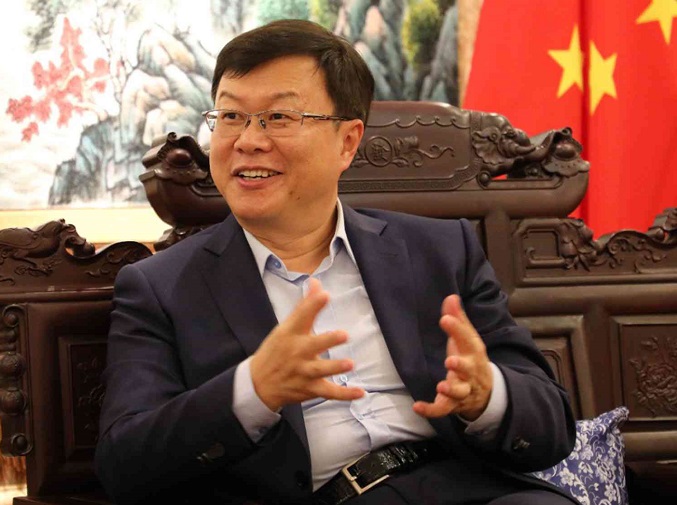
Chinese ambassador to Zimbabwe Zhou Ding