


Tapiwa Chirume
STAFF WRITER
STANBIC Bank Zimbabwe has signed a one-year revolving agreement with environmental organisation Ele-Collection to support waste management and local job creation.
The partnership tackles two interconnected challenges: plastic pollution threatening wildlife and the lack of viable income opportunities within surrounding communities.
Ele-Collection employs women who collect discarded plastic, creating an alternative source of income that helps reduce reliance on subsistence poaching across local wildlife species.
The organisation’s chief executive officer, Simon Teede, said Ele-Collection was born from a near-death encounter with an elephant. It was one of three separate elephant attacks in Victoria Falls that month. Two people lost their lives in the other attacks, whilst he and his companions survived.
Teede said that when the elephant was later put down, a significant quantity of plastic waste was found in its stomach — a stark illustration of the extent to which unmanaged plastic is entering wildlife habitats and being consumed by animals.
He noted that his near-death experience exposed, in an immediate and personal way, the growing intersection between unmanaged waste, wildlife, and surrounding communities.
Plastic ingestion can cause a condition known as plasticosis, involving plastic-associated inflammation, fibrosis, and scarring of the digestive system, which can cause death. Although most studies to date have focused on birds, emerging research indicates similar effects across other species that ingest plastic waste.
Teede suggested that the effects of plastic ingestion may have contributed to the elephant’s unusual aggression.
“Ele-Collection employs previously unemployable women who collect all types of plastic, even dirty, contaminated waste, which we then process into aggregate for concrete. Independent testing confirmed the product exceeded industry standards, earning certifications from the Standards Association of Zimbabwe, PPC Cement, and DuraCrete for use in commercial concrete applications,” said Teede.
“Ele-Collection is creating a different option. Our collectors now earn US$8 to US$10 per day recovering plastic from the bush. That is transformational income. That is food security. That is a livelihood that did not previously exist.”
Stanbic Bank’s partnership with Ele-Collection has helped transform plastic waste from an environmental threat into a source of income, providing meaningful livelihood opportunities for local women.
Teede expressed gratitude that Stanbic Bank has committed to funding the recovery of 36 tonnes of plastic over the course of this year — the equivalent of approximately 3,6 million 500ml plastic bottles.
The initiative has already seen the collection of nine tonnes of plastic in the last three months, avoiding 26,1 tonnes of emissions, which is equivalent to planting 435 urban tree seedlings.
Head of Business and Commercial Banking at Stanbic Bank, Patson Mahatchi, said the institution was pleased to support such a sustainability-focused initiative.
“Our institution supports tourism in a big way, hence we call Victoria Falls our home. It is thus fitting that this initiative resonates perfectly with our drive to achieve sustainability while serving the communities in which we operate,” said Mahatchi, adding that it was encouraging to participate in a self-sustaining project that creates viable alternative income streams.
Victoria Falls faces growing ecological pressures due to rapid urban development and expanding tourism. Ineffective municipal waste management has increasingly led to urban wildlife encounters.
Stanbic Bank Zimbabwe, a subsidiary of the Standard Bank Group, frequently invests in environmental, social, and governance (ESG) projects to mitigate conservation threats across rural Zimbabwean provinces.
Stanbic partners Ele-Collection in Victoria Falls
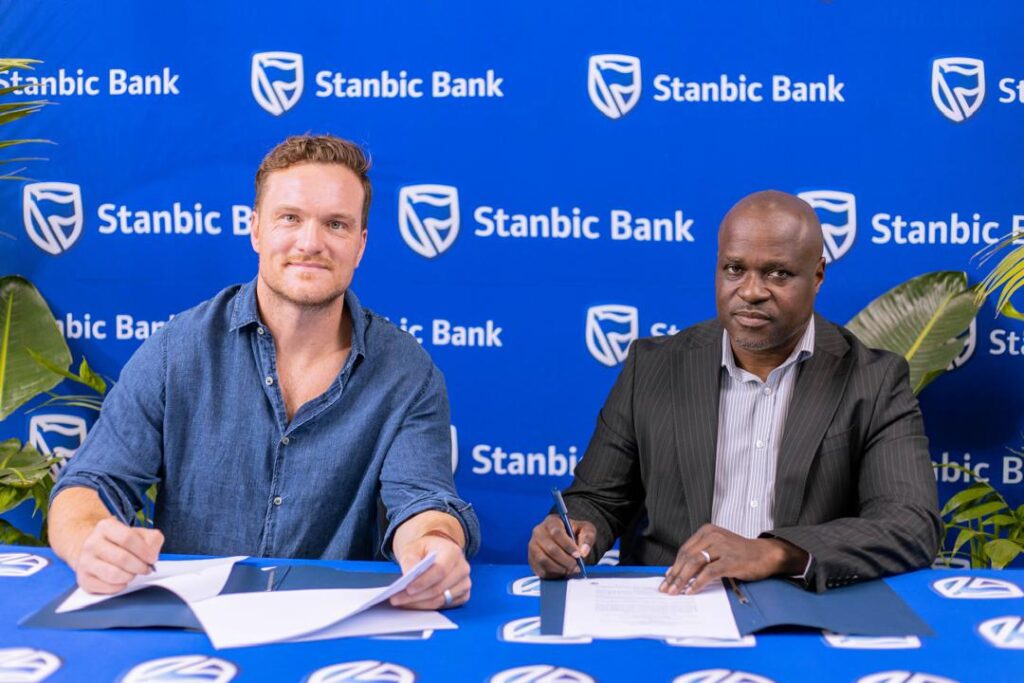
Ele-Collection Chief Executive Officer (CEO), Simon Teede (left) and Stanbic Bank Head Business and Commercial Banking, Patson Mahatchi at the signing ceremony.