


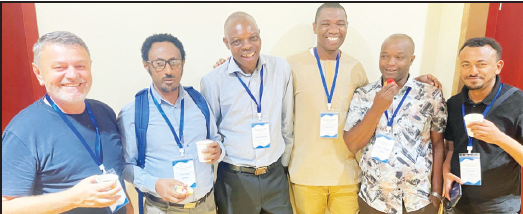
AFTER Tinashe Muchuri returned from China, we discussed his experiences at a cultural heritage seminar and the lessons Zimbabwe could draw from China’s approach to heritage conservation, education and entrepreneurship.
This article is based entirely on his responses to my questions, exploring how indigenous knowledge can be transformed into sustainable livelihoods and contribute to national development.
For Zimbabwean writer, storyteller, poet and multidisciplinary artist Muchuri, a cultural heritage seminar in China became a catalyst for rethinking the relationship between creativity, education, entrepreneurship and national development.
His experience raised a compelling question: how can Zimbabwe transform its ancestral knowledge and cultural inheritance into productive industries without compromising their historical significance?


Muchuri attended the Seminar on Conservation and Inheritance of Cultural Heritage for Countries along the Belt and Road, held from September 9 to 22, 2026.
Sponsored by the Ministry of Commerce of the People’s Republic of China and organised by the China Academy of Cultural Heritage, the seminar combined lectures, case studies, cultural experiences and visits to significant heritage sites in Beijing and Jingdezhen. The programme explored China’s approaches to heritage conservation, community participation, cultural-site management and the integration of cultural tourism with economic development. For Muchuri, however, its greatest lessons concerned Zimbabwe’s ancestral skills, rural communities, educational institutions and the possibilities of turning indigenous knowledge into sustainable enterprises.
In Beijing, lectures at the Twenty- First Century Hotel in Chaoyang District addressed the management of World Cultural Heritage Sites, community participation in heritage protection and innovations in conserving fragile cultural objects.
Visits to the Badaling section of the Great Wall, the Palace Museum and the Chinese Archaeological Museum demonstrated how heritage could be conserved, interpreted and made accessible to the public.
The Hongqiao Market offered a different perspective, illustrating the relationship between commercial exchange and cultural activity.
Together, these experiences demonstrated that heritage need not remain a static monument to the past.
Properly conserved and interpreted, it can sustain cultural practices, educate visitors and generate economic opportunities.
Yet it was Jingdezhen, renowned for its porcelain tradition, that provided Muchuri with his most personal and transformative encounter.
At Jingdezhen Ceramic University, participants engaged in ceramic painting, producing souvenirs with their own hands.
The exercise prompted Muchuri to reconsider the economic potential of his own background.
Born into a family of craftspeople and raised among them, he began to recognise possibilities he had previously overlooked.
Reflecting on the experience, he confessed:
“I was born into a family of crafters, raised by crafters but it never came to my mind that my ancestors’ skills can be modernized to turn around our family economy and have spillovers to the national GDP.”
His admission captures a central tension in the relationship between tradition and modernity. Indigenous knowledge is frequently celebrated as an emblem of cultural identity, yet it is not always integrated into contemporary systems of production, innovation and entrepreneurship.
Zimbabwe’s pottery traditions, for instance, could provide foundations for contemporary ceramic design, household products, artistic expression and cultural tourism.
The challenge is not merely to preserve the clay pot as an ancestral artefact, but to develop the knowledge, techniques and aesthetics behind its production into viable enterprises without erasing their cultural meanings. For Muchuri, the experience inspired thoughts about preserving heritage sites within his own chiefdom and revitalising traditional skills through modern production and marketing. A visit to the Sanbao International Ceramic Art Village further illustrated how traditional craftsmanship could be connected to contemporary artistic practice and community development. Rather than treating inherited skills as isolated activities, the experience highlighted their potential to contribute to the regeneration of places and local economies. It also prompted Muchuri to question Zimbabwe’s educational priorities.
“Why the universities more in cities and only teachers colleges are situated in rural areas?” he asked. He questioned why Zimbabwean colleges and universities were not doing more to draw upon the knowledge held by communities whose skills have been transmitted across generations. These questions extend beyond the geographical distribution of educational institutions to the epistemology of education itself: whose knowledge is recognised, what forms of expertise are valued, and how learning responds to the economic realities of communities.
Zimbabwe’s heritage-based curriculum provides an opportunity to address these concerns.
Beyond identifying traditional artefacts and describing cultural practices, learners could study the techniques behind them, experiment with contemporary applications and explore potential markets for their products.
Such an approach would bring formal education into a more productive dialogue with community knowledge, allowing universities to become spaces where traditional expertise and modern innovation reinforce each other. A particularly striking example emerged during Muchuri’s visit to Taoxichuan Ceramic Culture Industrial Park on 19 September. Its students’ market demonstrated how practical learning could be connected directly to entrepreneurship.
Students displayed and sold products made during their ceramic-production studies, gaining experience in manufacturing, presentation and commercial exchange before completing their education.
As Muchuri observed, “This empowerment is beyond the words on paper but practical.” His observation raises an important question for Zimbabwe’s education system. Entrepreneurship cannot be developed through theory alone; learners need opportunities to practise it.
Product development, exhibitions, marketing and sales can transform classroom knowledge into practical competence. The principle applies equally to pottery, sculpture, textiles, creative writing, photography, film and other artistic disciplines.
A finished work can become a product, service, performance or the beginning of a sustainable enterprise.
This does not mean every artist must become a businessperson, but artistic practice and economic literacy need not be mutually exclusive.
Muchuri’s multidisciplinary career provides a practical illustration of the opportunities that creative work can generate.
His achievements include the Delta Corporation Arts and Entertainment Journalist of the Year award at the National Journalism and Media Awards (Njama) for 2012–2013, the UNICEF Child Journalist of the Year award for 2013–2014, and a Certificate of Excellence for Arts and Entertainment Journalist of the Year for 2015–2016. He was nominated for the National Arts Merit Awards (NAMA) in 2015 in the Outstanding Journalist (Print) category and won the 2017 NAMA award for Outstanding Achievement in Journalism (Print). His children’s book Auntie Mazvita was nominated for the Outstanding Children’s Book award at the 2022 Nama ceremony.
His creative practice spans film, television, theatre, poetry performance, storytelling, short fiction and children’s literature.
His film credits include Tanyaradzwa, The Husband, I Will Survive, I Want a Wedding Dress, Nyami Nyami and the Eggs of Evil, Playing Warriors and The Story of Nehanda.
His television work includes Tiri Parwendo, Vhunze and New Dawn.
His theatre experience includes Oedipus Tyrannus, performed at the Harare International Festival of the Arts, and Dzimbabwe, which toured cities. In poetry performance, Muchuri has appeared at festivals and events in Zimbabwe and the wider Southern African region.
His poem Ibhinya was recorded alongside Trust Mutekwa’s Ndiwe for a radio programme connected to Katswe Sisterhood’s campaign against sexual abuse.
Mbiri Yenyu Baba was adapted into film by Ten Chitanana, while Zvinoda Kushinga featured on a billboard for the Mai Chisamba Show.
He was also repeatedly named Poet of the Month at the House of Hunger Poetry Slam, formerly held at Book Café.
His short story Naked Shots was adapted into a short film by Shingirai Manyengavana. He is the author of the novel Chibarabada and children’s books including Zvipfuyo Nevana Vazvo and Auntie Mazvita.
He also contributed Ant The Little Saviour to the Intwasa Festival of the Arts koBulawayo’s Around the Fire folktales book. This professional trajectory illustrates how creative practice can transcend disciplinary boundaries. Journalism can lead to recognition and international exchanges; literature can enter classrooms, publishing markets and film adaptations; poetry can reach audiences through festivals, radio and public campaigns; and storytelling can preserve cultural knowledge while creating opportunities for performance.
Muchuri’s experience therefore challenges the perception that the arts are economically unproductive or offer limited career prospects.
Creative work can generate professional networks, collaborations, recognition and opportunities for international knowledge-sharing.
His career also demonstrates how different artistic disciplines can complement and strengthen one another.
On September20, the delegation returned to Beijing. A visit to the Summer Palace on September 21 offered further insights into the relationship between culture, planning and national identity.
Its imperial gardens illustrated the deliberate organisation of architecture, space and landscape, reinforcing for Muchuri the importance of intentionality in national development.
The broader lesson is that cultural heritage does not preserve itself.
It requires planning, investment, research, skilled practitioners and institutions capable of transmitting knowledge across generations.
Zimbabwe possesses its own heritage sites, craft traditions, historical narratives and artistic practices.
The challenge is to connect these resources more systematically with education, community participation, tourism and creative enterprise.
This does not mean copying China’s cultural or economic model wholesale; Zimbabwe must develop approaches suited to its own histories, communities and material circumstances. Nevertheless, international experiences can reveal possibilities that familiarity sometimes obscures.
Muchuri’s reflections invite Zimbabweans to reconsider what it means to inherit a culture.
Inheritance need not be a passive process in which traditions are received and preserved unchanged.
It can involve preservation, reinterpretation and innovation, provided inherited skills are modernised without being emptied of their cultural meaning. Achieving this would require stronger partnerships between universities, artisans, cultural institutions, local authorities and communities. Traditional crafts could benefit from practical training, contemporary design, product development and access to markets.
Heritage sites could be better interpreted for visitors, while cultural tourism could create opportunities for local guides, performers, writers, craftspeople and small businesses.
Such initiatives require more than inspirational rhetoric.
They demand research, funding, infrastructure, intellectual-property protection and sustainable mechanisms to ensure that communities benefit from the cultural resources they preserve.
The arts, therefore, are more than instruments of entertainment. They are repositories of memory, forms of knowledge, and vehicles of cultural diplomacy and potential sources of employment.
Muchuri’s journey offers a compelling reminder that creative practitioners can be both custodians of cultural memory and participants in economic transformation.
His visit to China may have begun as a seminar on heritage conservation and inheritance, but it brought him back to a deeply Zimbabwean question: what can a people do with the knowledge their ancestors left behind? The answer lies partly in recognising that cultural inheritance is not merely something to celebrate during commemorations or display in museums. It is something to study, develop, teach, perform, produce and share with the world.
For an artist, the arts can become a passport to international experiences; for a community, a means of preserving identity and generating livelihoods; and for a nation willing to invest in its own knowledge, a resource for sustainable development.
Muchuri’s Chinese experience is ultimately an invitation to look at home with renewed imagination and discover that some of the resources needed for the future may already be embedded in the skills, stories and traditions of the past.
NB// About the writer— Nelson Mutongi is a biographer, music analyst, literary critic, book reviewer, teacher, Publishing Consultant, editor and MC. He is the author of “Hwatsvira Hwemvumvira” and “Pieces of Silver,” and co-author of “Jongwe neSheche” and “Kuchema neKunakirwa” You may connect with him via email nelsonmutongi01@gmail. com | WhatsApp: 0771 647 246