


Kudzanai Gerede
STAFF WRITER
LOCAL businesses must urgently adopt Artificial Intelligence (AI) and also invest in human capital to ensure long-term viability in an increasingly volatile global economic landscape.
Speaking at the prestigious Top Companies Survey (TCS) Awards in Harare yesterday, tech expert and chief executive of Timbuktoo Africa Innovation Foundation, Natalie Jabangwe, also observed that the pace of technological development around the world was now “exponential”.
At the same time, and amid the economic headwinds that are affecting many businesses, the Group Chief Executive Officer of Jester Media Services (JMS), Pilate Machadu, said the multimedia company — which continues to defy media sector trends by achieving commercial sustainability and growth — was “totally committed” to dedicating significant resources to supporting commerce and industry.
The esteemed TCS awards are organised by the Daily News’ JMS stablemate newspaper, The Financial Gazette — the country’s number one business publication — in partnership with diversified financial services giant, Old Mutual Zimbabwe.
“The rate at which technological development is taking place is absolutely exponential.
“It is not the strongest of species or the most intelligent that survives, it is the one that is most adaptable to change.
“You might be sitting with a group of executives who have the best actuarial degrees, who have the best in-class business models, but it’s not really about that.
“It is actually the best at adapting that will be able to move across and change,” Jabangwe told the oversubscribed TCS awards event.
She added that technological disruption was changing how businesses operated, while AI was accelerating the pace at which information, skills and business processes were being transformed.
In this regard, Jabangwe said companies needed to view adaptability as a strategic capability — particularly as the traditional drivers of economic growth were being reshaped by technology.
While gross domestic product (GDP), investment, consumption, trade and other conventional measures remained important, she argued further that companies needed to pay greater attention to productivity, technology and human capital.
Jabangwe also challenged companies to play a bigger role in developing the country’s future business leaders and technology entrepreneurs.
On his part, the chief investment officer of Mutapa Investment Fund (MIF), Simba Chinyemba, said the fusion of AI and human skills needed to be managed carefully.
He also said AI was increasingly outperforming humans in areas such as processing information and solving complex problems — although technology could not yet replace the human qualities required to make responsible business decisions.
Chinyemba added that companies needed to understand the respective strengths and weaknesses of humans and machines, and design systems that combined the two.
“Humans are limited in their ability to process vast amounts of information and could suffer from decision fatigue, particularly when required to make repeated decisions over long periods,” he said further.
Old Mutual Zimbabwe group chief executive, Sam Matsekete, weighed in, stressing the need for businesses to adapt to change.
“We are lso moving from opportunities that we have generically seen in the past to emerging opportunities presented by AI.
“The challenges may change, but as they change, so do new opportunities emerge.
“And, the one constant that remains amongst all those changes is the need for businesses to adapt to create sustainable value for the community,” Matsekete said.
“When we celebrate businesses that do well, we are recognising the role that business plays in the development of the economy.
“Businesses that are well run in the economy will also benefit more effectively,” he added.
Speaking on the sidelines of the awards, Machadu said Jester Media Services Group would continue to play its part in promoting business, while charting a path of robust commercial sustainability and aggressive multi-platform growth.
He added that while some major media houses were grappling with shrinking advertising budgets and hyperinflationary pressures, JMS had managed to transform the crisis into an opportunity.
“Through strategic technological adoption and bold asset diversification, our group has solidified its position as a market leader, offering a vibrant blueprint for the future of local and regional media.
“At the core of JMS’s success is our successful transition from being just a legacy print publisher into an agile, multimedia ecosystem.
“It is on this basis that the group’s portfolio now features iconic print staples like The Financial Gazette and the Daily News, seamlessly integrated alongside its fast-growing digital platforms, and its leading private commercial broadcasting assets, 3Ktv and Radio 3000,” Machadu said further.
“We refuse to view the current economic environment as a permanent barrier, but rather as an invitation to innovate.“Our growth is anchored on a relentless commitment to our audiences and business partners.
“By expanding our footprint across print, digital and broadcasting, we have created an interconnected ecosystem that maximises value for both our consumers and our advertising partners,” Machadu also said.
“Our multi-platform strategy allows an advertiser to walk into our offices and launch a campaign that hits print, digital web banners and winning, prime-time television simultaneously. That is our competitive edge.
“Rather than scaling back operations to cut costs, our group has doubled down on premium content production and tech-forward distribution.
“This proactive stance has allowed JMS to sustain high-quality journalism, while maintaining strong financial health,” Machadu added.
“The modern media landscape belongs to those who embrace disruption rather than fear it.
“JMS will continue to invest in digital innovation and content excellence to ensure that we remain the most trusted voice in media in Zimbabwe,” he also said.
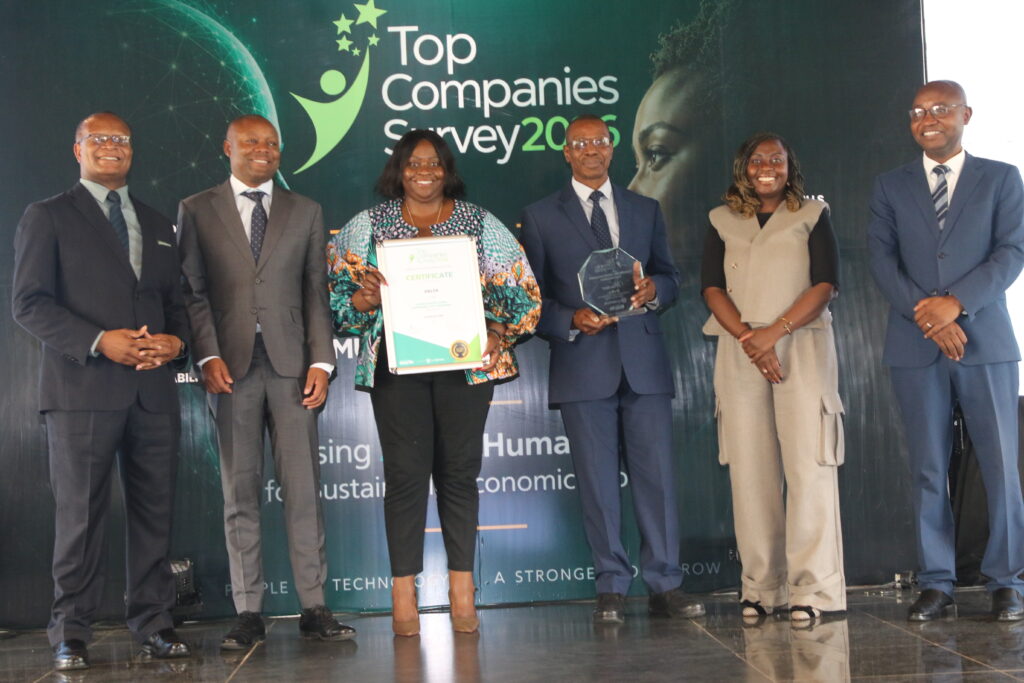
Meanwhile, diversified beverages giant, Delta Corporation, once again scooped the overall award for this year’s top company, while Econet and Caledonia took second and third place respectively.
The Top Companies Survey Awards evaluate firms listed on the Zimbabwe Stock Exchange and the Victoria Falls Stock Exchange, alongside sector-specific categories — measuring financial performance, balance-sheet strength and investor returns.
The event also celebrates excellence in investor relations, insurance, mining, environmental, social and governance (ESG) practices, as well as disclosure and transparency.
Last year, Delta Corporation and Caledonia Mining Corporation shared the main Top Company accolade, following strong performances across both domestic exchanges.
As usual, this year’s edition of the awards brought together top executives, investors and policymakers to recognise and celebrate the best of Zimbabwe’s corporate leadership.